


Everyone is obsessed with the software side of AI right now. We are captivated by the LLMs that can write code, the video generators that create movies from text, and the agents that act as our personal assistants.
But as the world looks at the screen, nobody is looking at the floor.
Data centers are the massive, overheating warehouses that make your ChatGPT prompts possible. They are the beating hearts of 2026. Right now, a quiet crisis is brewing inside them. It isn’t a software bug or a bad algorithm. It is a physical limit.
The AGI Bottleneck
As we scale toward AGI (Artificial General Intelligence, AI that can perform any intellectual task a human can), the sheer volume of hardware required is exploding. We are moving from clusters of 10,000 GPUs to campuses with millions of them.
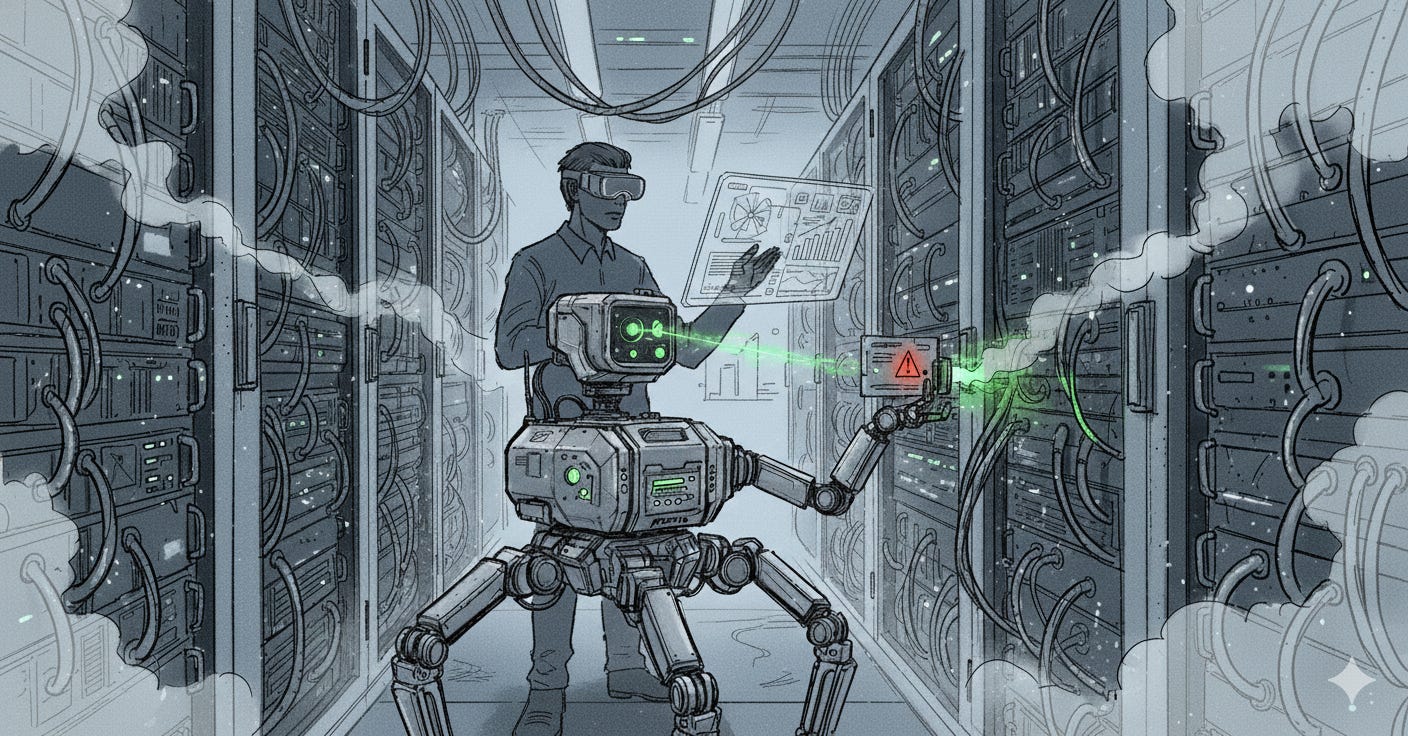
These facilities are loud, they are hot, and they are miles long. When a server rack fails or a cooling pipe leaks, a human has to walk those miles in 100-degree aisles to find the fault. In a world where compute is the most valuable commodity on earth, we are running out of humans who can work that fast.
This is where the “Day Zero” energy lives. While the mega-caps are throwing money at models, a two-person team in Boston is building the mechanics that will keep the lights on.
Who is behind Boost Robotics?
I’ve been tracking the Physical AI wave in Boston, and the team at Boost Robotics caught my eye. Hans Kumar and Hardik Singh are a two-person squad with a background that suggests they know exactly how hard this problem is to solve.
According to their Y Combinator founder profile, their bond goes way back to 2015, when they met as engineering freshmen at CMU. They actually spent years together on a competitive Bhangra dance team before they ever built a robot together.
Hans was a Staff Software Engineer at Boston Dynamics (the world leader in mobile robotics), where he worked on productizing the Spot inspection robot. Hardik was the robotics lead at an agtech startup where he successfully pivoted a product to market in just one month.
The Market Landscape
To understand why a tiny team like Boost Robotics is a heavy hitter, you have to look at the 2026 market. We are currently in an Infrastructure Supercycle, which is a multi year investment phase where companies spend more on “the foundation” - buildings, power, and hardware - than on the software itself. Global spending on AI is forecast to reach a staggering $2.52 trillion this year. Within that, hyperscalers like Microsoft and Google are expected to spend over $500 billion specifically on infrastructure.
The industry has moved from the Training era, where the focus was on building models, to the Inference era, where those models are actually deployed for users. This shift requires “always on” reliability. The biggest threat to the boom isn’t a lack of code, it’s now a lack of uptime.
The Verdict
The East Coast is becoming a powerhouse for Physical AI. We are seeing a shift away from “another SaaS app” toward hard-tech solutions that solve boring, massive, trillion-dollar problems. Keep an eye on Boost Robotics. They are moving fast to ensure the physical world can keep pace with the digital one. They are not just riding the wave. They are building the surfboard.
⚡ The Wave Report
Team: 2 founders (Hans Kumar & Hardik Singh)
Status: Active (Y Combinator Spring 2025 Batch)
The Mission: Build autonomous mobile robots that perform manual tasks in data centers
Find them: boostrobotics.ai