


Startup capital didn’t slow down this week, it just got more specific. Investors are chasing companies that own a real workflow (tax, compliance, security, energy, sales) instead of ones selling a vibe. Here are the five stories shaping the week, and what they signal for where the next wave of startups is headed.
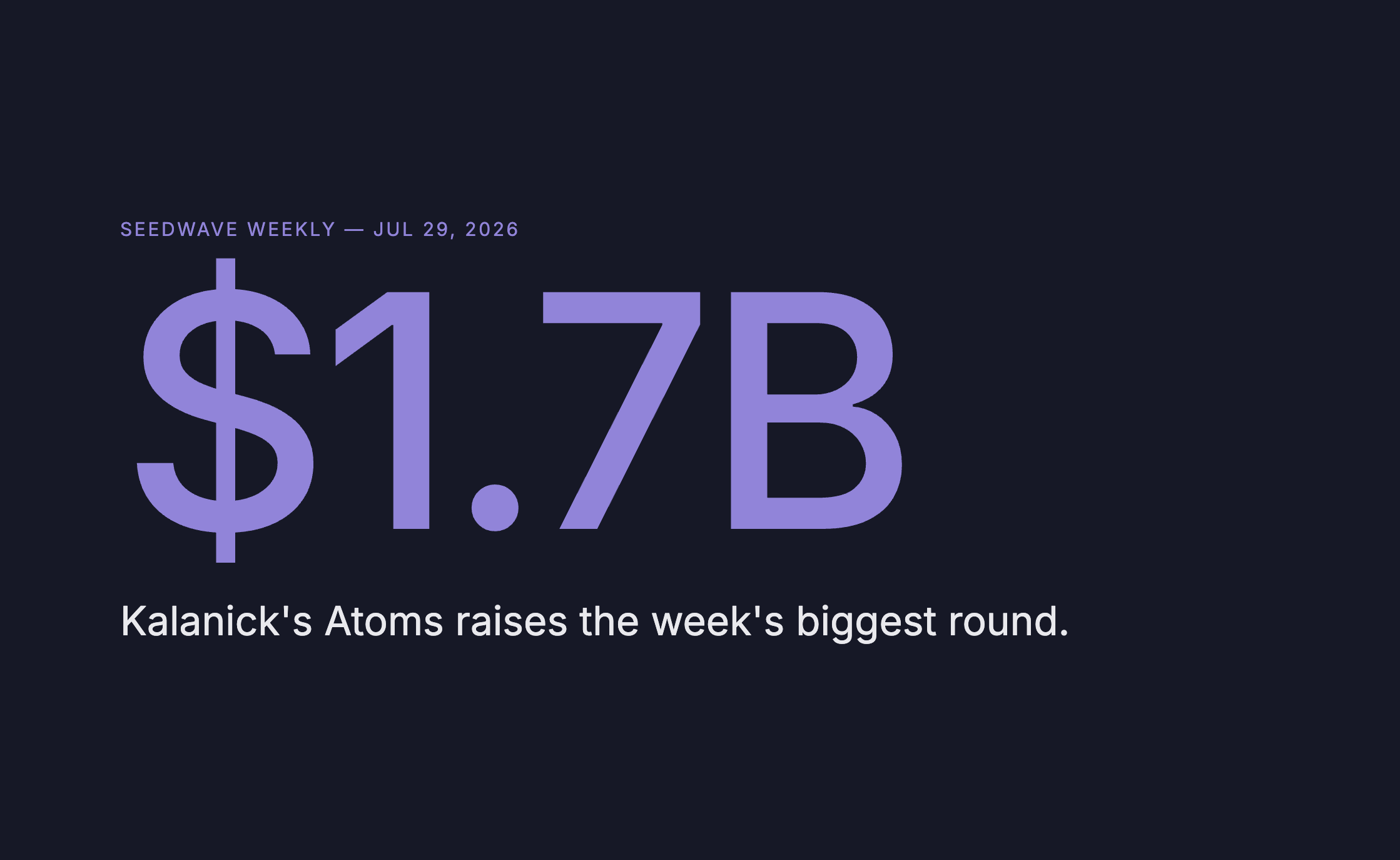
1. Atoms raises $1.7B to build “physical AI,” the week’s biggest round by far
Travis Kalanick’s newest venture, Atoms, closed a $1.7 billion round led by Andreessen Horowitz, with Ben Horowitz taking a board seat. New investors include Bain Capital, Fifth Wall, Chemistry, A*, K5 Global, Abstract, SV Angel, and Alpha Square Group, and Uber itself also joined the round, reconnecting Kalanick with the company that pushed him out as CEO in 2017. “Physical AI” (AI systems that operate in the real world rather than just on a screen) is quickly becoming the label VCs reach for to describe the next act after the LLM boom. It’s part of a record year for robotics funding, which has already hit $55.8 billion globally.
2. Meshy AI hits a $1.5B valuation on $400M Series B
Meshy AI, a startup building foundation models for AI-generated 3D content, raised nearly $400 million in a round co-led by IDG Capital, Matrix Partners China, and Monolith, at a $1.5 billion valuation. It’s the largest round to date in AI 3D generation, a category that’s been quietly heating up as gaming, VFX, and industrial design teams look for AI shortcuts to 3D asset creation. The company says its annual recurring revenue is growing about 12x year over year, with over 12 million registered users.
3. Sila raises $300M to scale US battery anode production
Battery materials company Sila closed a $300 million round led by Atreides Management and Sutter Hill Ventures, with 8VC, Bessemer, Matrix Partners, and T. Rowe Price also participating. The money will expand its Moses Lake, Washington plant, adding enough silicon-carbon anode material for more than 100,000 EVs. Battery materials sit at the intersection of AI infrastructure (data centers need power) and the EV supply chain, two theses VCs are betting will only get more capital-hungry.
4. Centralize emerges from stealth with a $15M Series A
Smaller than the megadeals above, but a good signal in its own right: enterprise sales platform Centralize came out of stealth with a $15 million Series A led by NEA, joined by Salesforce Ventures, Y Combinator, and angel investors including Slack co-founder Stewart Butterfield. Combined with an earlier seed round, the company has raised $19 million since 2023 to build what its founders call a “deal GPS” for enterprise sales teams, already used by Sierra, ElevenLabs, Cognition, and Brex.
5. The bigger picture: money is concentrating, not spreading out
Crunchbase’s weekly roundup calls it a “varied week for large deals,” but the pattern underneath is consistent. Capital is flowing to AI infrastructure, fintech, biotech, cybersecurity, and defense: sectors where startups control something customers already need and budget for. Separately, the US government gave OpenAI the green light to roll out its most advanced model globally after a staggered preview, one more sign of how much weight “government approval” now carries in the AI race. That demand is already straining memory chip supply: Gartner projects prices could climb roughly 130% by the end of 2026, pushing PC prices up 17% and smartphone prices up 13%.
The takeaway: if you’re building or backing something right now, “polished story” isn’t the unlock anymore. The rounds getting done are going to teams solving an expensive, specific problem, fast.